
Quick Commerce Warehouse Boom
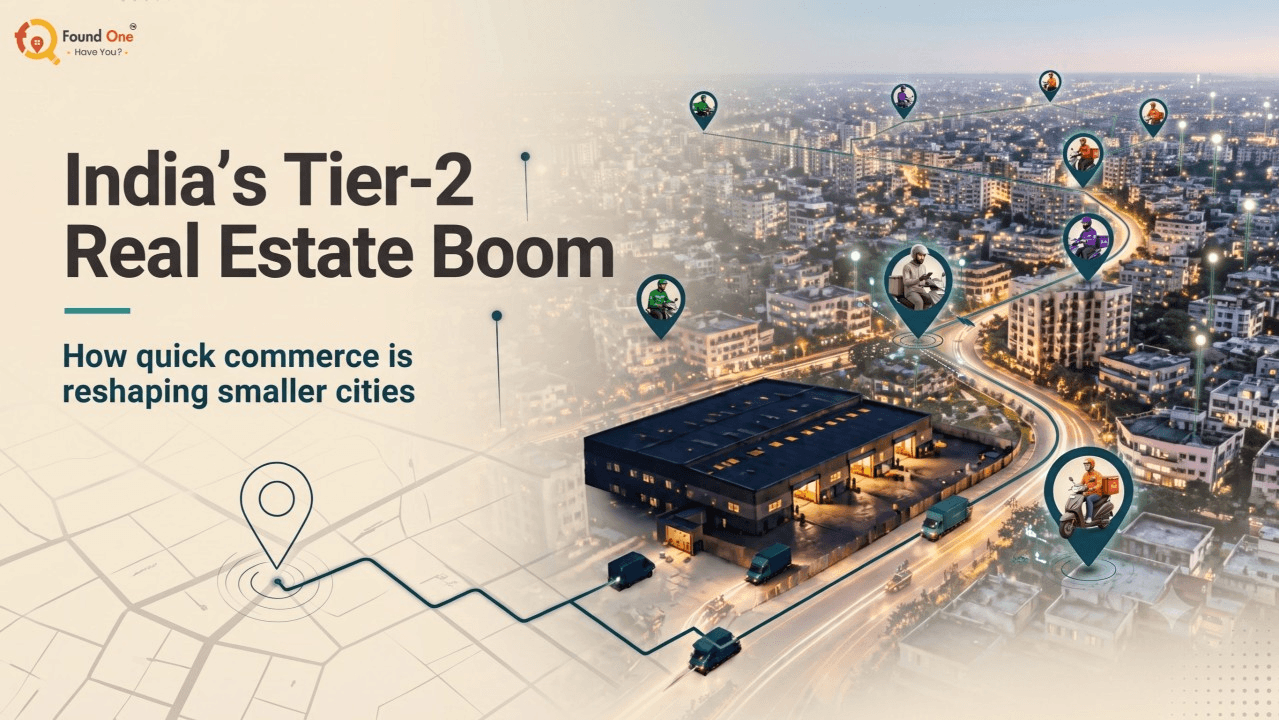
How Blinkit, Zepto, Instamart, and Amazon are quietly turning India's smaller cities into the country's next big real estate story.
September 22, 2026
Quick Commerce Warehouse Boom
Why Tier-2 Real Estate Is India's Next Investment Hotspot (2026)
How Blinkit, Zepto, Instamart, and Amazon are quietly turning India's smaller cities into the country's next big real estate story.
It Started with a Shuttered Bank Branch
Sometimes, the biggest changes in real estate don't start with a new building.
They start with a tenant leaving one.
Consider a commercial space in Delhi's Sant Nagar. An ICICI Bank branch once operated on the ground floor. Six months after the bank moved out, the "Commercial Space for Rent" sign was still hanging outside.
The reason was sitting right below it.
A Blinkit dark store had moved into the basement, with delivery riders coming and going throughout the day.
It sounds like a small, almost ordinary real estate story. But it points to a much bigger shift.
Quick commerce is no longer just a retail story. It is becoming a real estate story too.
Companies such as Blinkit, Zepto, Instamart and Flipkart Minutes need strategically located spaces close to the customers they serve. And as they expand beyond India's largest metros, that requirement is beginning to reshape demand in smaller cities.
And here's the part that should really get an investor's attention: that story is no longer confined to Delhi and Mumbai. It's spreading to Jaipur, Indore, Coimbatore and closer to home, Dehradun.
If you're sitting on capital and wondering where the next real estate cycle is quietly building, this is worth ten minutes of your time.
Why Are the Smaller Cities Suddenly the Story?
Three things are happening at the same time.
The metros are getting crowded. Blinkit, Zepto, and Instamart already have a strong presence across Mumbai, Delhi-NCR, Bengaluru, and Hyderabad. Growth there increasingly means competing for customers in neighbourhoods that are already well served.
Smaller cities are catching up. Flipkart Minutes reported 5X year-on-year order growth, while Tier-2 and Tier-3 markets grew 42X compared with the previous year.
And quick commerce is getting bigger. The model is moving beyond small grocery-focused stores, with larger "mother warehouses" supplying 6,000-8,000 sq. ft. fulfilment centres closer to customers.
More cities. Bigger spaces. More demand for strategically located real estate.
That makes quick commerce a real estate story too.
What the Map Actually Looks Like Today
Blinkit's lead isn't subtle. In FY26 alone, it opened 942 new dark stores, and a lot of that expansion went straight into cities where its rivals hadn't shown up yet. Industry watchers have a name for this: a land grab. Get there first, optimize the economics later.
Why should a real estate investor care about a corporate strategy playbook?
Because whoever picks the right plot first - before four other platforms are bidding on the same street - locks in the lowest rent and the best location. Once that street is crowded, the advantage is gone.
Dehradun: A City Caught Mid-Story
If you want to see this trend without squinting at a national headline, Dehradun is a good place to look because it's neither empty nor already crowded. It's somewhere in between, which is exactly the stage where an investor's timing matters most.
As of a neighbourhood-level mapping update dated 10 July 2026, Dehradun had 49 quick-commerce dark stores. Blinkit was out in front with 17 stores, roughly 35% of the city's footprint, trailed by Zepto and Swiggy Instamart with 9 each, BigBasket with 8, and Flipkart Minutes with 6.
A few things jump out from that same data:
Some pockets are already getting crowded. Seema Dwar alone has four Blinkit stores. But at the same time, roughly 18 neighbourhoods across the city had no Blinkit store at all as of that update.
Remarks: the race has clearly begun, but the map is far from full.
Competitors keep landing near each other. Several dark stores across platforms sit within 100-500 metres of a rival's store. For a landlord, that's actually good news: a well-chosen commercial spot could plausibly attract more than one platform's interest over the years, not just a single tenant you're betting everything on.
Hospitals and colleges matter as much as housing. At least one Blinkit store sits near Medilife SuperSpeciality Hospital rather than downtown in line with the broader pattern of operators favouring catchments near hospitals, campuses, and newer apartment complexes over old city centres.
Dehradun isn't special because it's unique. It's useful because it's typical - a live, readable example of what "early, but not first" looks like in a Tier-2 state capital.
The Opportunity - and the Part that still is read between the lines
Here's what all this demand actually translates into for an investor: small-format commercial units, roughly 1,000-3,000 sq. ft., with ground-floor access and decent loading space, sitting close to dense housing, hospitals, or campuses. At the other end of the spectrum, larger regional distribution hubs on the city outskirts feed that mother-warehouse layer.
But an honest advisory piece has to say the uncomfortable part too: quick commerce in Tier-2 cities is genuinely slower than in the metros. One delivery-time analysis found average delivery times in Tier-2 cities running 15-23 minutes across Blinkit, Zepto, and Instamart, well above the 8-13-minute range typical of metro hubs like Mumbai, Delhi, and Bengaluru.
That doesn't mean the trend is hype. It means not every platform's Tier-2 bet is built on equally solid ground, and it's worth paying attention to who's making individual stores profitable versus who's simply spending to hold territory ahead of a listing. Some industry commentary suggests operators with an existing logistics-and-brand advantage (Blinkit's tie-up with Zomato's delivery network, for instance) are better positioned to sustain this expansion than smaller, capital-constrained rivals, but that's analyst opinion, not a promise.
The Golden Takeaway: How to Actually Find the One
Strip away the jargon, and here's our honest advisory answer to the question every investor is really asking: out of hundreds of Tier-2/3 micro-markets, how do I find the right property before everyone else does?
Look for cities that are "early but not empty." Not the metros, too crowded, too expensive. Not cities with zero quick-commerce presence too early, too risky, no proof of demand yet. The sweet spot is a city like Dehradun today: multiple platforms already operating, but clear neighbourhood-level gaps still unfilled. That's the golden window: proof of concept exists, but the best spots haven't been bid up yet.
Follow the neighbourhood data, not the press release. A company announcing "we're expanding into 50 new cities" tells you almost nothing about which street to buy on. Store-level mapping data like what showed Seema Dwar's clustering and Dehradun's uncovered pockets is what actually tells you where the next lease will get signed.
Pick locations that work even if one tenant doesn't. Since rival platforms so often compete for the same catchment, the smartest play isn't finding "the Blinkit building" - it's finding the building that any of five platforms would want. That's what keeps a property earning rent through the inevitable shakeout ahead of the sector's 2026 public listings.
Treat the mother-warehouse layer as the quieter goldmine. Everyone's chasing small dark stores. Almost nobody's chasing the larger 10,000+ sq. ft. distribution hubs feeding them less competition, longer leases, more institutional-grade tenants.
Never build something with only one possible use. The golden opportunity here isn't a bet on quick commerce surviving forever. It's a bet on well-located, flexible commercial real estate that quick commerce happens to be filling right now and that can just as easily become a retail store, a clinic, or a café if the tenant changes tomorrow.
That's the real advisory takeaway: the opportunity isn't chasing the biggest expansion number in a headline. It's reading the neighbourhood-level story, the one still being written in cities like Dehradun and getting there while the map still has gaps.
The Bigger Picture
This isn't happening in isolation. Nearly half of all land acquisitions by Indian developers, by area, are now happening in Tier-2/3 cities, and logistics and warehousing assets outside Tier-1 markets have become one of the most actively pursued categories for institutional investors. Quick commerce is one of the biggest accelerants of that shift right now, alongside Global Capability Centre-driven office demand and infrastructure-led growth in emerging micro-markets. For an investor thinking in years rather than months, someone looking for both land appreciation and steady rental income, not a quick flip, this combination is exactly what a golden entry period looks like. Land in these emerging micro-markets is still priced for what the city is today, not for what it's becoming. Buy well-located land or commercial space now, while quick commerce, GCC-driven office demand, and infrastructure spending are all pulling in the same direction, and you're underwriting two return streams at once: the property's own appreciation as the city matures, and rental income from tenants who need exactly this kind of space today.
The takeaway isn't "build a warehouse near a growing city." It's understanding which cities are actually being prioritized, what kind of space each operator needs, and how solid that operator's economics really look, because this trend tells a very different story depending on whether you're reading the headline number or the street-level data underneath it.
- Advisory perspective from FoundOne
Frequently Asked Questions
A dark store is a micro-warehouse or local fulfillment center used exclusively for online shopping deliveries. Unlike traditional retail shops, it is closed to the public and specifically optimized for fast order packing and dispatch by delivery riders.
While traditional warehouses are massive regional distribution hubs typically located on the outskirts of cities, dark stores are much smaller (usually 1,000–3,000 sq. ft.). They are strategically placed right in the middle of dense residential neighborhoods, hospital catchments, or college campuses to enable 10 to 20-minute deliveries.
Tier 1 refers to India's major metropolitan areas (like Delhi, Mumbai, and Bengaluru) which have mature, highly-priced real estate markets that are currently getting crowded. Tier 2 refers to fast-growing mid-sized cities (like Dehradun, Indore, and Jaipur) that offer lower real estate entry costs, less competition for prime spots, and significant upside for early investors.
As major metros become saturated, quick commerce platforms like Blinkit, Zepto, and Swiggy Instamart are looking for their next phase of growth. Tier-2 cities are catching up rapidly in terms of consumer demand, prompting a "land grab" by these companies to lock in the best neighborhood commercial spaces before their competitors do.
The sweet spot is finding cities that are "early but not empty"—where proof of demand exists but prime locations haven't been bid up yet. Investors should look for 1,000–3,000 sq. ft. ground-floor units with decent loading space near dense housing. Crucially, choose flexible locations that would appeal to any of the major delivery platforms, ensuring steady rental income regardless of which single tenant wins the market.
Explore more insights


Have a question
about your next real estate decision?
Explore the journal or speak with an advisor about your specific situation.